Burnout Retreat for Women
More women arrive at my burnout retreat for women describing exhaustion more than anything else.
From the outside, things often look intact. Work is getting done. Life is being managed. They are capable, responsible, often the one others rely on.
But internally, something feels worn down or worn out but their body and mind keep repeating the cycles. Will power, understanding, mindfullness or apps have little or no effects.
A constant level of pressure.
A loss of energy.
A sense of carrying too much for too long.
What Burnout Feels Like
For many women, there is no clear stopping point.
No finish line.
Even when something is done, it doesn’t feel done.
There is always more to do, more to hold, more to manage.
And underneath that, something else:
A pressure from within.
A sense of needing to keep going.
Anxiety that doesn’t fully switch off.
A quiet but persistent feeling of not quite being enough.
This is not simply stress.
This is a nervous system that has been under sustained load for too long.
Where It Comes From
When I speak to women about burnout, I often start with a simple statement:
You only have to do enough to get the job done.
For some, that brings relief.
For others, it creates immediate discomfort.
Because for many women, enough has never felt like enough.
This is rarely about work itself.
It is usually something older — a pattern formed early, where more was required, or where approval depended on doing more, being more, holding more.
Over time, that becomes internal.
No matter how much is done, the system does not register completion.
There is no sense of arrival.
No contentment.
Just a continuation.
Women and Burnout
Women are often expected to carry more.
To work, to manage, to care, to anticipate, to hold things together — often without pause, and often without recognition.
A woman’s work is never done is not just a phrase. It becomes a lived structure.
Over time, that structure becomes internal.
Even when external demands reduce, the internal pressure remains.
This is where burnout deepens.
What We Do Here
This burnout retreat for women does not treat burnout as something to manage.
We work with what is driving it.
There are only five women at a time. The therapeutic work is one-to-one, private, and paced according to your capacity.
You are not asked to speak about your history in a group. There are no sharing circles, no performance, and no pressure.
Alongside the individual work, the week includes small group workshops, somatic therapy, and gentle trauma-informed yoga — supporting understanding and allowing the body to settle.
The environment matters.
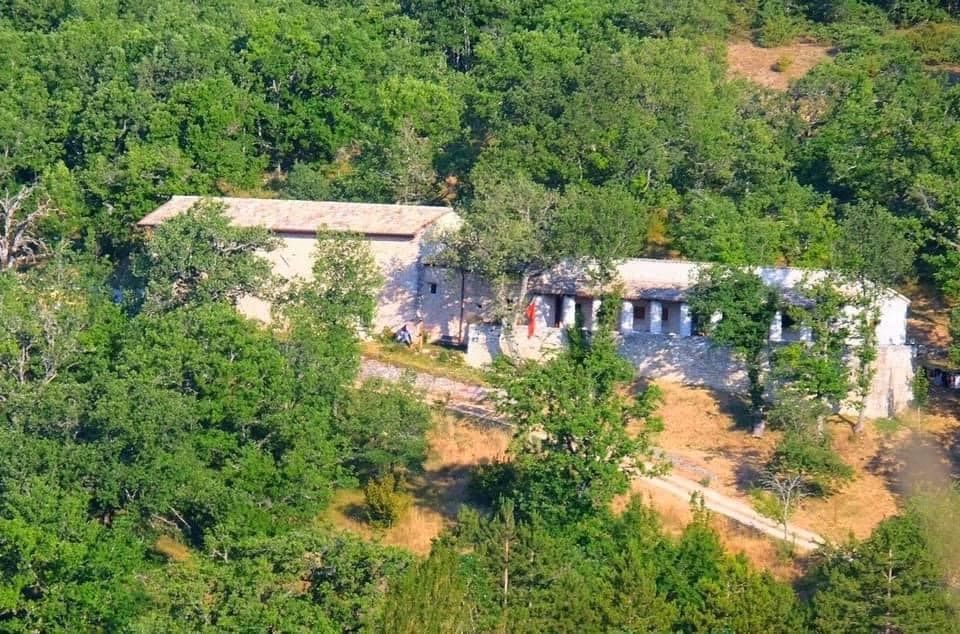
Time outdoors, shared meals, quiet, and space are not extras. They are part of how the nervous system begins to come out of constant effort.
What Changes during my burnout retreat for women
The aim is not to make you do less.
It is to allow your system to recognise when something is complete.
To feel, at a body level, that enough has been done.
When that happens, something shifts.
The internal pressure begins to ease.
The constant drive softens.
The nervous system settles.
For many women, this is the first time that enough is not just understood, but actually felt.
Burnout often brings women here because something has reached its limit. Not dramatically, but quietly — a sense that continuing in the same way is no longer sustainable, even if everything still appears to be working from the outside.
A Small, Carefully Held Week
This is a seven-day residential burnout retreat for women.
Led by trauma psychotherapist Tess Hunneybell — with over twenty years of experience in trauma-informed residential retreat work.
Each retreat is intentionally small, with a maximum of five women. This allows the therapeutic work to remain personal, private and carefully paced.
Our 2027 retreat programme is currently being finalised. Please contact me directly for current information about dates, availability and location.
If you feel the pull, it’s worth paying attention to that.
If you’d like to understand how the week works and whether it’s right for you:
Or email tess@healingtraumaretreat.com if you’d prefer to write first.
If you’d like to understand how the week works, what’s included, and whether it’s right for you:
Or email tess@healingtraumaretreat.com if you’d prefer to write first.